WC/C (WCC) Coating for Reduced Friction and Wear
Reduced friction and wear in highly loaded steel contacts, mixed-friction conditions, and start-stop operation.


The Cr/CrN/WC/C tribo coating system at a glance – featuring a multilayer structure for strong adhesion, low friction, and reliable wear protection.

For demanding tools, every surface matters. Titanium nitrideTiN is a proven PVD coating that provides reliable protection, long tool life and a wide range of applications. With HiPIMS, the TiN coating is further improved: denser in structure, more uniform on the surface and more robust in use.
Discover how HiPIMS-TiN makes tools more efficient in everyday applications.

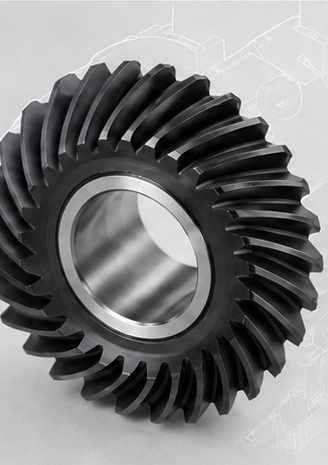
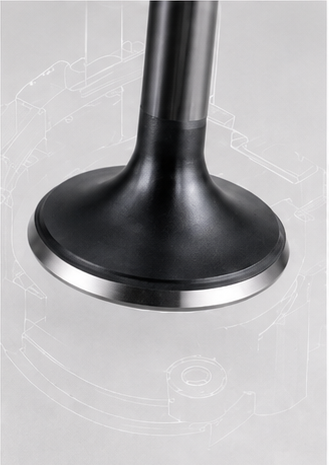
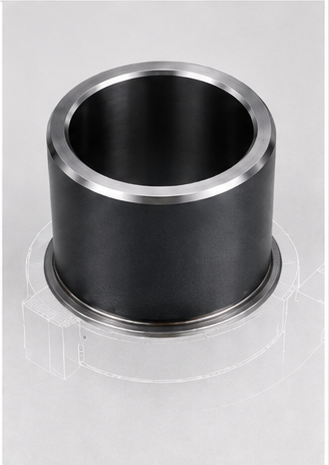
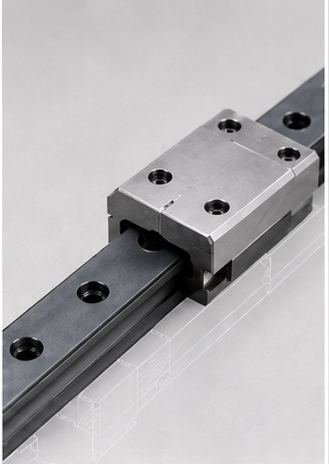
WCC Tribo is an anthracite-coloured protective coating for components that move, slide, or rub against other metal parts under load. It reduces friction, protects against wear, and supports reliable function even where lubrication is not always optimal.
The coating is particularly suitable for components with steel contact, high surface pressure, small movements, or repeated start-stop operation. Typical applications include highly loaded sliding contacts, drive components, damper parts, and mechanical systems with mixed-friction conditions.
In short: WCC Tribo helps components slide more easily, last longer, and perform more reliably under demanding conditions.

Many technical components do not operate under ideal conditions. During start-up, stopping, short strokes, or limited lubrication, high friction occurs. In precisely these situations, the surface determines function, service life, and operational reliability.
WCC Tribo was developed for these tribological loads. The coating combines low friction against steel with high wear resistance and a technically high-quality anthracite-coloured surface.
The coating is particularly interesting when friction is not just a side effect, but a function-critical factor. It can help make movements smoother, protect contact surfaces, and reduce wear in highly stressed areas.
The friction performance of WCC Tribo was tested in a pin-on-disk test against a steel ball made of 100Cr6. The measurement was carried out dry, at room temperature, using the Anton Paar TRB3 tribometer. Loads of 2 N, 10 N, and 20 N were tested.
The key result: As the load increases, the average coefficient of friction decreases.
This measurement series shows: WCC Tribo can achieve a low and stable friction level under higher contact loads.

A low coefficient of friction means that two contact surfaces slide past each other more easily. As a result, less heat can be generated, energy loss is reduced, and wear in the contact area is decreased.
In real-world applications, this is particularly important when no consistently stable lubricating film is present. This applies, for example, to start-stop movements, short strokes, high local contact pressures, or changing loads.
WCC Tribo is therefore particularly interesting for components where friction, wear, and functional reliability are closely connected.

WCC Tribo was tested against 100Cr6 steel. The results show that the coating achieves lower average coefficients of friction as the test load increases.
The range at 10 N and 20 N is particularly relevant. Minimum values below μ = 0.1 were measured here. This makes WCC Tribo suitable for applications that require low friction against steel, load-bearing capacity, and wear protection at the same time.
The key message for the application is: WCC Tribo supports a low friction level in loaded steel contacts and can offer particular advantages where lubrication, start-stop loading, or mixed friction are critical.
The low coefficients of friction measured at higher loads can be explained by the characteristic running-in behaviour at the beginning of the pin-on-disk test.
| Property | WCC Tribo |
|---|---|
| Coating type | Tribological wear protection coating |
| Coating system | WC/C |
| Specification | a-C:H:Me |
| Structure | Multilayer system |
| Technology | PVD sputtering |
| Colour | Anthracite |
| Coating thickness | 3-5µm |
| Max. application temperature | <200°C |
| Process temperature | <250°C |
| Coating adhesion / HF class | HF1-3 |
| Suitable substrates / materials | Low- and high-alloy tool steels |
| Typical component sizes / batch sizes | D150x500 mm |
| Coating hardness HV (composite hardness) | approx. 1,000–1,500 HV |

A tribological coating must match the component. The key factors are the base material, friction partner, load, movement, temperature, medium, and required service life. That is why RUBIG does not evaluate WCC Tribo in isolation, but in combination with the specific application.
The RUBIG Coating Centre has the analytical capabilities to technically validate coating systems and assess them in relation to the application. This allows the coating, component, and operating conditions to be precisely coordinated.
With the scanning electron microscope, surfaces, wear marks, fracture edges, and coating structures are made visible. This makes it possible to assess whether a surface has been subjected to abrasive, adhesive, or local coating-damage-related stress.
EDX complements this analysis with chemical information. For WC/C coatings, this is important in order to technically classify tungsten, carbon, and interface areas.
The coating thickness influences wear reserve, dimensional accuracy, and edge behaviour. For series components, it must therefore be coordinated with function and tolerance.
Coating adhesion is evaluated using established methods such as the HF indentation test according to the Rockwell method.
The scratch test loads the coating with increasing normal force. This makes it possible to assess at which load cracks, chipping, or delamination occur.
For customers, this is particularly relevant when several coating variants, substrates, or pretreatments are compared.
The high-load tribometer measures how a coating behaves under defined frictional load. WCC Tribo was tested against 100Cr6 – dry, at room temperature, and with loads up to 20 N.
The measured values show a decreasing average coefficient of friction with increasing normal force. This is particularly relevant for applications with higher contact loads, because not only the lowest individual value is considered, but also the behaviour across the load range.
Tribological components often operate not only under mechanical load. Media, condensate, cleaning chemicals, or corrosive environments can also influence function.
Corrosion analysis supports the selection and evaluation of the appropriate coating system.
The coating hardness was determined by nanoindentation according to ISO 14577. This method is particularly suitable for thin technical coatings because it works with very small indentation depths and, in addition to hardness values, also provides information on elastic-plastic deformation behaviour.
For the technical evaluation, not only HV values are therefore relevant, but also Martens hardness, indentation hardness, and indentation modulus.

Rocker arms operate with varying forces, contact loads, and sometimes critical lubrication conditions. WCC Tribo can help reduce friction and wear at the contact surface.
The coating is particularly relevant where high local contact pressures, start-stop loads, and steel contact come together.

Differential gear shafts are locally highly loaded components with small relative movements and steel contact. The combination of a load-bearing WC/C structure and a low coefficient of friction makes WCC Tribo interesting for this application.
The coating can help reduce wear in the contact area and improve sliding behaviour under load.

Steering dampers generate repeated sliding movements. Stable, low friction is important for consistent function and reduced wear in the contact area.
WCC Tribo can help stabilize friction and reduce wear on coated sliding surfaces.

Whether WCC Tribo is suitable for the application depends on the specific component. The key factors are the base material, friction partner, load profile, movement, temperature, and medium.
For an initial technical assessment, a component drawing, material specifications, friction partner, load, movement speed, lubricant or medium, temperature range, target quantity, and the existing wear or friction problem are helpful.
Based on this, RUBIG will assess whether WCC Tribo is suitable for your application and which further tests are useful for technical approval.
Managing Director RUBIG Technology
