All the key properties of our coatings. At a glance.
Hardness, coating thickness, maximum service temperature, coefficient of friction and adhesion for every PVD, PACVD and multilayer coating from the RUBIG Coating Center. Compare, filter, sort — and inquire directly.
And if none of them fits: we develop your coating.
Coating overview
Comparison table of all coating systems
Sort by clicking a column heading. Every technical term has an i — clicking it explains in two sentences what the value means and what to look out for.
Custom solutions
None of these coatings fits? Then we'll develop one that does.
The table above shows our standard range — it is not a catalog you have to choose from. If your component, your material or your load case calls for a different solution, we develop the coating system together with you. That sets us apart from suppliers who can only deliver what is on their list.
Coating thickness beyond the standard
The ranges given are empirical values from series production. Greater coating thicknesses are possible if your application needs them.
Color shade to specification
TiN and ZrN can be adjusted from light gold to brown, ZrCN from light gold-bronze to dark bronze. For design applications, we match your color coordinates.
Process tailored to your material
The coating temperature is determined by your tempering temperature — not the other way round. For sensitive components, we run the process at a correspondingly lower temperature.
Coating architecture and combination
Multilayer systems, adapted adhesion layers or the combination with an upstream heat treatment in the duplex process.
Why we can do this
Because we build the coating equipment ourselves. MICROPULS® Lotus system technology is created in-house, and materials engineering is located in the same plant. A custom process is therefore not a special case for us, but a setting on equipment we know down to the last detail — and not the limit of a bought-in machine.
Noteworthy
Three values that make the difference
TiBN — the hardest coating in the portfolio
Titanium boron nitride achieves 4000 ± 500 HV with a maximum service temperature of around 900 °C. For highly abrasive loads where TiN and TiCN reach their limits.
WC/C-Tribo — lowest coefficient of friction
Tungsten carbide/carbon in a multilayer structure, measured dry against 100Cr6. The answer to insufficient lubrication and micro-motion at component temperatures up to 250 °C.
HiPIMS delivers +400 HV with the same chemistry
Conventional TiN versus TiN-HiPIMS: identical coating chemistry, higher hardness and one adhesion class better (HF1–HF2 instead of HF1–HF3). This is the measurable effect of an ionization level of over 90%.
Individual data sheets
Every coating in detail
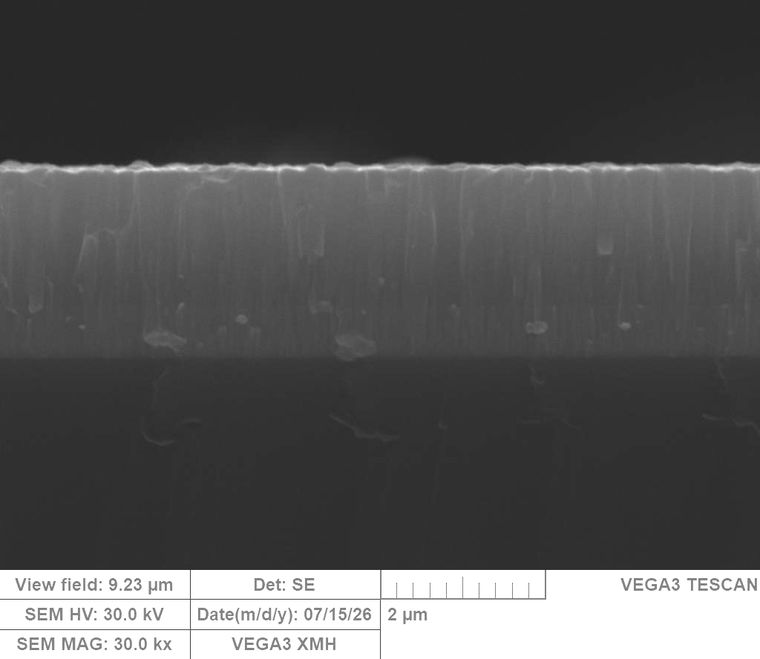
Complete properties including roughness and L*a*b* color coordinates, plus the microscopic image of the coating cross-section from our laboratory. Click a coating to open it.
In practice
Coated components
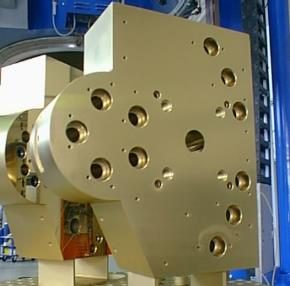
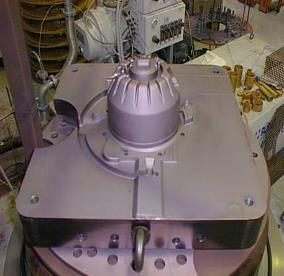
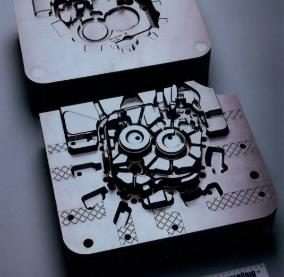
From one-off parts to series components — tools, molds and machine parts from the RUBIG Coating Center.
Frequently asked questions
About the properties
Why are all values based on 1.3343?▸
High-speed steel 1.3343 (HS 6-5-2 C) is the usual reference material for coating tests. Hardness, adhesion and roughness always depend on the substrate — only with a uniform reference can the coatings be compared with one another. For your specific component and material, we state the values to be expected as part of your inquiry.
What do the adhesion classes HF1 to HF3 mean?▸
The HF classification evaluates the fracture pattern of a standardized indentation test in the coating. HF1 is the best class — only fine cracks, no delamination. HF6 would be the worst. All RUBIG coatings are in the range HF1 to HF3; the PACVD titanium coatings and TiN-HiPIMS consistently achieve HF1 to HF2.
Coating temperature or service temperature — which do I need to watch?▸
Both. The coating temperature determines whether your component survives the process without loss of hardness — it must be below the tempering temperature of your material. The maximum service temperature limits subsequent operation. For tempered tool steels with a low tempering temperature, CrN Mod. (200–300 °C) and the multilayer coatings (≤ 200–250 °C) are the right choice.
Does the coating increase the roughness of my component?▸
With the PVD coatings, generally not — the coating replicates the existing surface. With the PACVD titanium coatings, roughness increases measurably: on a sample polished to Ra 0.02 µm, Ra values between 0.03 and 0.08 µm result after coating, depending on the coating. The exact value is given in each individual data sheet.
Does the coating change the dimensions of my component?▸
Practically not. The coatings are between 0.5 and 6 µm thick, i.e. between one two-thousandth and six thousandths of a millimeter. For fits in the hundredths-of-a-millimeter range this is negligible — for very tight tolerances, we take the coating thickness into account in the design.
Can I get greater coating thicknesses?▸
Yes. The ranges given are standard values. Greater coating thicknesses or extended properties are possible on request — contact us with your application.
What if none of the listed coatings suits my application?▸
Then we'll develop one that does. The table shows our standard range, not the limit of what is possible. Coating thickness, color shade, process temperature and the coating architecture itself can be adapted, among other things — right through to the combination with an upstream heat treatment.
This is possible because we build the coating equipment in-house and materials engineering is located in the same plant. Tell us about your component, material and load case — we'll clarify the rest together.
Not sure which coating is the right one?
Send us your component, material and load case — we will suggest the right coating system and state the values to be expected for your material.
+43 (0) 7242 / 211 210 · te.office@rubig.com
